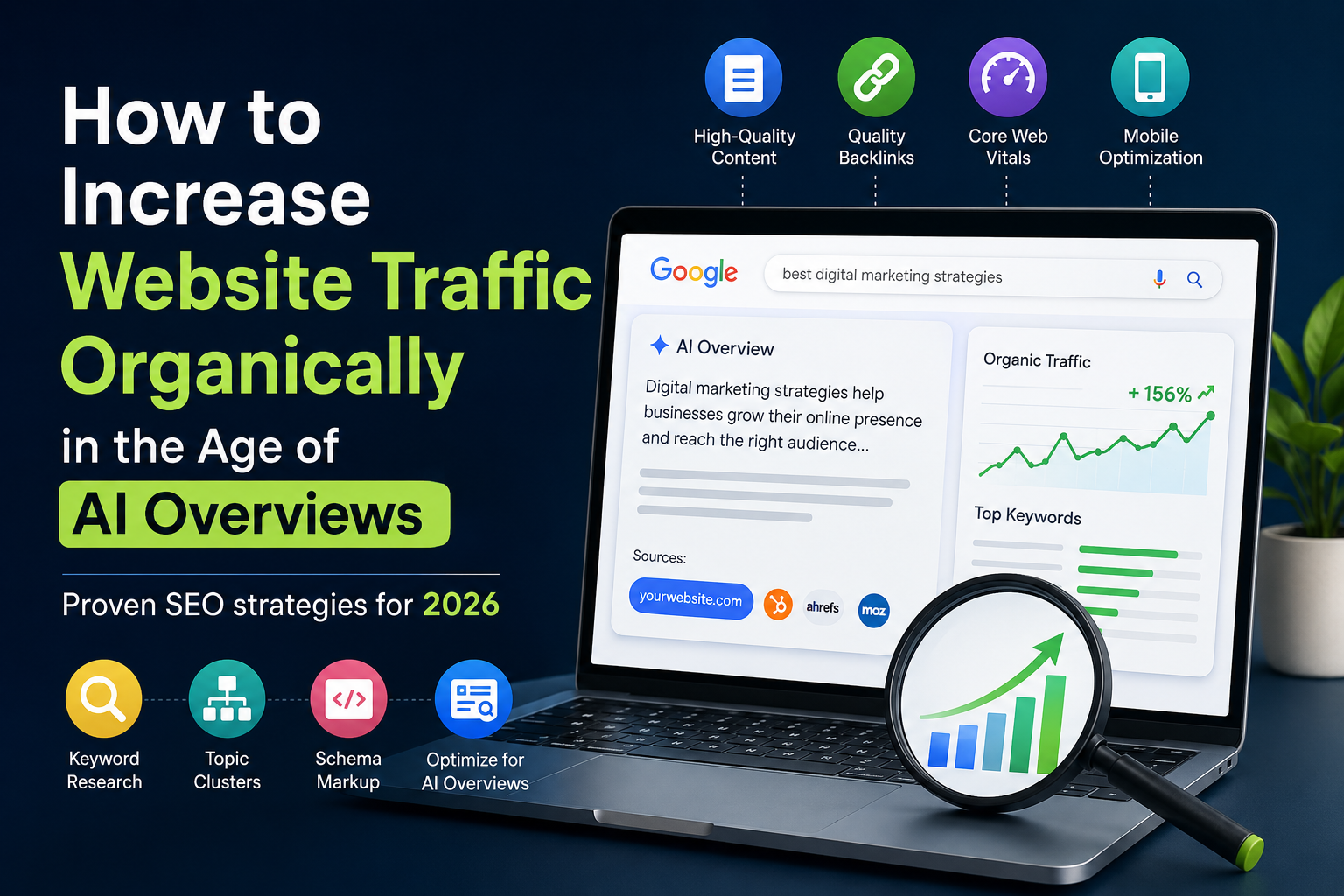
Search doesn’t work the way it did two years ago. Google now shows an AI-generated answer above the search results for a huge share of queries, and a growing number of people never click through to a website at all. If your traffic has stalled even though your rankings look fine, this is almost certainly why.
This guide breaks down what’s actually changed in 2026 and what to do about it, without the recycled advice that stopped working a while back.
What Changed: Search Has Split Into Two Systems
For most of the last two decades, “SEO” meant one thing: rank higher in the ten blue links. That’s no longer the full picture.
Search today runs on two parallel systems:
- Traditional organic search, the classic ranked list of web pages.
- AI-generated answers, Google’s AI Overviews, plus AI assistants like ChatGPT and Gemini that pull and summarize information directly.
Zero-click searches, where someone searches but never clicks a website, have crossed 60% of all queries. Some analyses put it even higher for certain topics like health and B2B research. When an AI Overview appears on a search, organic click-through rate drops sharply compared to when it doesn’t.
Here’s the part that matters most for your strategy: a large majority of the sources AI Overviews cite are already ranking in the traditional organic top 10. Winning a normal ranking spot and getting cited by an AI Overview aren’t two separate battles. They’re the same battle, just with an extra layer on top.
That reframes the whole question. It’s not “how do I rank higher.” It’s “how do I rank high enough, and structure my content clearly enough, that both a human and an AI system want to point people to me.”
1. Optimize for AI Overview Citations, Not Just Rankings
Ranking in the top 10 gets you in the room. Getting cited inside the AI Overview gets you the visibility, even when the click doesn’t happen.
To improve your odds:
- Answer the question in the first two sentences. AI summarization tools pull direct, self-contained answers. Bury your answer in paragraph four and it’s less likely to get lifted.
- Use clear, structured formatting. Headers, numbered steps, and short paragraphs are easier for both search engines and AI systems to parse and extract cleanly.
- Write one clear answer per section. Sections that try to cover three ideas at once are harder to cite cleanly than sections with one clear, complete thought.
Even without the click, a citation builds brand recall. Someone who sees your brand name inside an AI answer three times is far more likely to search for you directly later.
2. Build Entity-Based Topic Clusters, Not Keyword Lists
Old-school SEO optimized one page per keyword. In 2026, both Google and AI systems reward topical authority, meaning a cluster of connected content that thoroughly covers a subject area, not just a single well-optimized page.
Practically, this means:
- Pick a core topic (your “pillar”), not just a single keyword
- Build 8-15 supporting articles that each answer a related sub-question
- Link them all together with clear, descriptive anchor text
- Make sure your pillar page links out to every supporting piece, and each supporting piece links back
This structure signals depth and expertise, both of which matter more now that AI systems are trying to identify which sites are genuinely authoritative on a subject versus which ones just happen to rank.
3. Win Featured Snippets and Zero-Click Real Estate
If a real share of searches will never result in a click no matter what you do, the smart move is to own as much of the no-click real estate as possible. Featured snippets remain one of the highest-performing formats on the page in terms of click-through rate, even in a zero-click-heavy environment.
To target snippets:
- Structure content with a clear question as a heading, followed immediately by a concise, direct answer
- Use numbered lists and tables for “how to” and comparison content, since these formats get pulled into snippets more often
- Keep the direct answer under roughly 50 words, then expand with detail afterward
4. Publish Genuinely Comprehensive Content
Longer content still consistently outperforms shorter content in traffic, shares, and backlinks. That doesn’t mean padding a post to hit a word count. It means actually answering every reasonable follow-up question a reader would have, in one place, so they don’t need to search again.
A good test: after reading your piece, would someone need to open another tab to get the full picture? If yes, there’s a gap to close.
5. Earn Backlinks With Original Data, Not Just Opinions
Original research and proprietary data earn meaningfully more backlinks than opinion-based or purely explanatory content. In a world where AI-generated summaries are common, having a data point that only exists because you ran the study is one of the few things that can’t be replicated by a competitor’s AI-assisted content.
This doesn’t have to be a massive undertaking. Even a small survey of your own customers, or an analysis of your own product’s usage data, can become a citable, linkable asset that outperforms a generic “ultimate guide.”
6. Fix the Technical Fundamentals: Core Web Vitals and Mobile Experience
None of the above matters if your site is slow or breaks on mobile. Google’s Core Web Vitals and overall page experience remain a real ranking factor, and the majority of global traffic now happens on mobile devices.
Priority checklist:
- Confirm your largest content element loads quickly, not just the overall page
- Check that your site doesn’t shift layout as it loads, which frustrates users and hurts your score
- Test your actual mobile experience yourself, not just a desktop view shrunk down
- Fix broken links and redirect chains, which quietly bleed both users and crawl budget.
7. Measure Conversion Quality, Not Just Traffic Volume
Traffic from AI-referred sources tends to convert at a meaningfully higher rate than traditional organic traffic, likely because the user arrives with a more specific, pre-qualified intent. That means a smaller number of the right visitors can outperform a much larger number of loosely related ones.
Shift your reporting to track:
- Conversion rate by traffic source, not just session count.
- Scroll depth and return visits, which reveal real engagement.
- Assisted conversions, where organic content plays a role earlier in a longer buying journey.
Chasing raw traffic numbers alone can lead you to optimize for the wrong content.
8. Diversify Where “Organic” Discovery Happens
Organic discovery in 2026 isn’t limited to Google. Video content, community platforms, and AI chat referrals are all becoming meaningful sources of the traffic that used to come exclusively from search engines.
Practical steps:
- Repurpose your best-performing blog posts into short video explainers
- Make sure your content is structured well enough to be crawled and cited by AI platforms, not just Google
- Track referral traffic from AI assistants separately, since it’s currently one of the fastest-growing categories
The Bottom Line
Organic traffic isn’t disappearing. It’s being redistributed. The sites still winning in 2026 are the ones that treat AI Overviews and traditional rankings as one connected system, publish genuinely complete answers, back their authority with real data, and keep the technical basics tight enough that none of it gets undermined by a slow, broken, or hard-to-crawl website. Start with the fundamentals: fix your technical foundation, build topic clusters instead of isolated pages, and structure your content so both a human reader and an AI system can find a clear answer fast. Everything else compounds from there.
FAQs
1. How can I increase website traffic organically in 2026?
The best way to increase website traffic organically in 2026 is by creating high-quality content that answers user intent, building topic clusters, optimizing for Google AI Overviews, improving Core Web Vitals, earning quality backlinks, and publishing content that demonstrates Experience, Expertise, Authoritativeness, and Trustworthiness (E-E-A-T).
2. What is the fastest way to increase organic traffic to a website?
The fastest way to grow organic traffic is to update existing content, target long-tail keywords, improve on-page SEO, optimize for featured snippets, and create content that answers common user questions. Improving internal linking and fixing technical SEO issues can also deliver quick wins.
3. Do Google AI Overviews reduce website traffic?
Yes, Google AI Overviews can reduce clicks for some search queries because users often get answers directly on the search results page. However, websites that are cited in AI Overviews can still gain visibility, brand awareness, and highly qualified traffic.
4. How do I optimize my content for Google AI Overviews?
To optimize for AI Overviews, answer the main question early in your content, use descriptive headings, create well-structured sections, include FAQs, add schema markup where appropriate, and publish accurate, authoritative information backed by reliable sources.