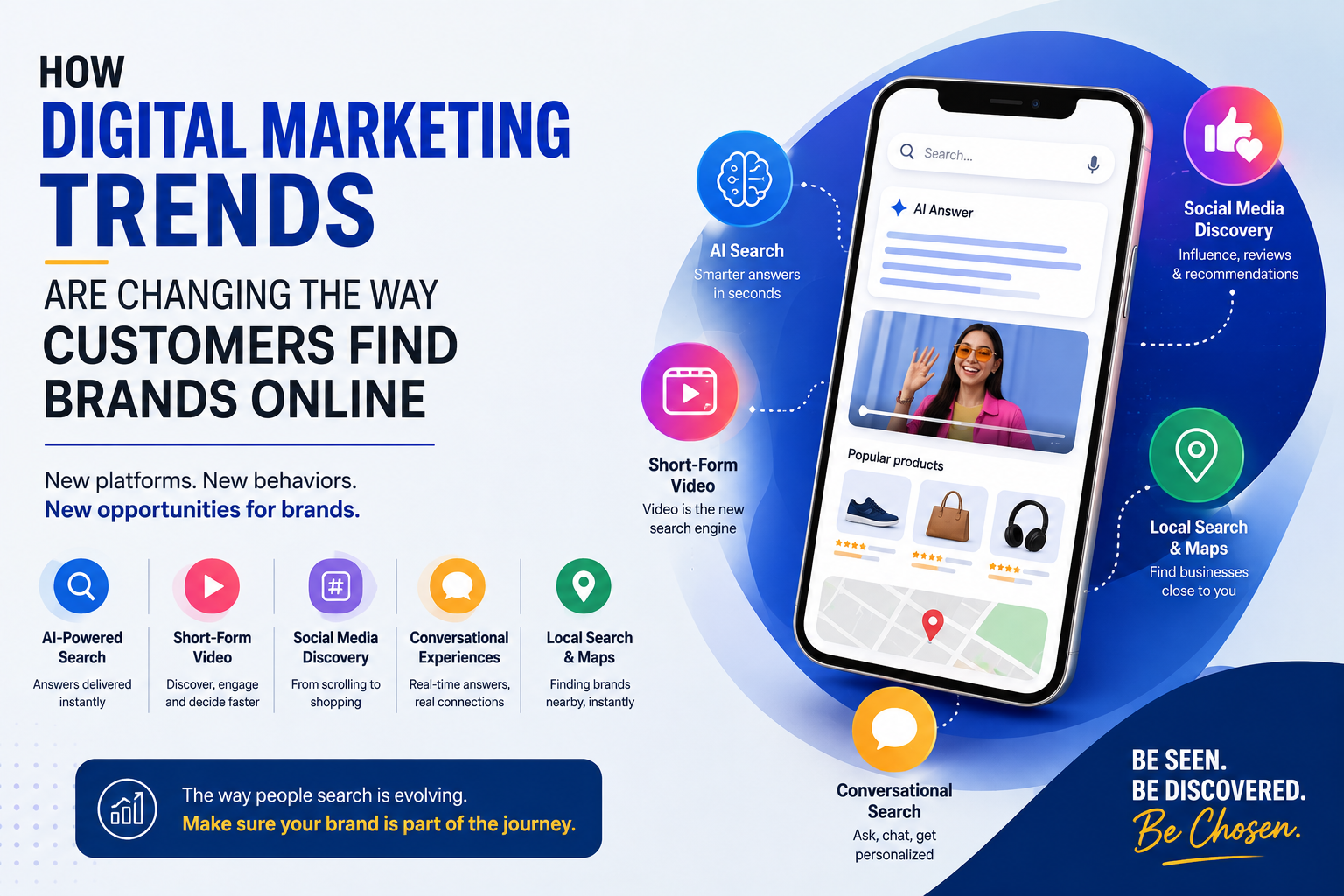
A few years ago, finding a brand online meant one thing. You typed a query into Google, scanned ten blue links, and clicked through to a website. That pattern is breaking down fast.
Today, customers discover brands through AI summaries that never send them to a website, short videos on platforms like Instagram, and recommendations buried inside a chat interface. The digital marketing trends behind this shift are not small tweaks. They are changing the basic mechanics of how attention turns into a customer.
This blog explains what is actually happening, backed by real data, and what it means for any brand trying to stay visible.
1. The Search Box Is Losing Its Monopoly
For two decades, ranking on Google was the main goal of digital marketing. That goal still matters, but it no longer tells the full story.
Search behavior itself has changed. People type a question, get an answer directly on the results page, and never visit a site at all.
The Numbers on Zero-Click Search
- 68% of US Google searches now end without a click to any website, up from roughly 60% two years earlier (SparkToro / Similarweb clickstream data)
- 83% zero-click rate when an AI Overview appears on the results page, compared to search results without one. Only about 1% of AI Overview views lead to a click on the cited source (Pew Research Center)
This does not mean visibility has disappeared. It means visibility has moved. Being named inside an AI answer is now doing the job that a top-three ranking used to do. Brands still get seen. They just get seen without a visit.
2. Gen Z Is Searching in a Different Place Entirely
While Google adjusts its results pages, an entire generation is bypassing search engines from the start. Gen Z is not abandoning Google outright, but they are running searches across multiple platforms depending on what they need.
The Numbers on Gen Z Search Behavior
- 67% of Gen Z use Instagram for search, running nearly as high as the 61% who use Google (Forbes, using GWI data)
- 30.4% of Gen Z shoppers find products most often on Instagram, versus just 18.8% who name Google as their top discovery source (eMarketer, citing Grin)
- Younger consumers increasingly rely on social platforms for restaurant recommendations, product reviews, and how-to content in visual, feed-based formats rather than traditional search results
For brands, this means a listing on a website or a ranking on Google is only part of the discovery journey now. A large share of younger buyers are forming their first impression of a brand inside a scroll feed, not a search results page.
3. Short-Form Video Has Become a Discovery Engine, Not Just a Format
Video used to be treated as one content type among many. That framing no longer holds. Marketers are now leaning on video not just to entertain, but to get found in the first place.
The Numbers on Video and ROI
- Short-form video is now the most used media format among marketers, and 21% say it delivers the highest ROI of any format they use (HubSpot State of Marketing Report)
- Short-form, long-form, and live video together now account for the majority of reported ROI across all content formats marketers track
This lines up with what platforms themselves show. People are not just watching short videos for entertainment. They are using them the way they once used a search bar, to compare products, check reviews, and decide where to go or what to buy.
The practical shift for marketers is this: a short video answering a real customer question can now do the discovery work that a blog post or landing page used to do, especially with younger audiences.
4. AI Search Is Changing What “Ranking” Even Means
AI is no longer a side feature of search. It is becoming the main way many queries get answered, which changes what it means to be visible online.
The Numbers on AI Search Adoption
- AI Overviews now appear on more than 20% of Google searches, and that figure keeps climbing (Search Engine Land)
- Google’s AI Mode passed one billion monthly users by mid-2026, with query volume more than doubling every quarter (Google, I/O 2026)
- 80% of search users rely on AI summaries for at least 40% of their queries, even though only 6% say they trust these summaries “a lot” (Bain & Company)
This is pushing marketers toward a new discipline sometimes called Generative Engine Optimization, or GEO. The goal is no longer only to rank a page. It is to become a source that AI systems choose to cite or summarize when they answer a customer’s question.
People use the AI shortcut even when they are not fully convinced by it. That gap between high usage and moderate trust is exactly why appearing as a cited, credible source matters more than ever.
5. What This Means for Brands Right Now
Put together, these trends point to one underlying shift. Discovery has moved from a single search box to a scattered set of surfaces: AI answers, social feeds, video platforms, and traditional search results all at once.
Practical Takeaways for Brands
- Write for the answer, not just the click. Since a large share of searches never lead to a website visit, content needs to be structured so an AI system can lift a clear, accurate answer out of it, with your brand name attached.
- Treat short videos as a discovery channel, not a nice-to-have. With short-form video delivering the highest reported ROI among marketers, per HubSpot, brands without a real video presence are missing a growing share of how customers actually find them.
- Show up where Gen Z actually looks. With Instagram now running close to Google for search among Gen Z, per Forbes and GWI data, a brand’s presence on visual social platforms needs the same intentionality as its website SEO.
- Track visibility, not just clicks. Traditional click-through metrics undercount how many people saw and trusted a brand through an AI Overview or a social platform. Newer metrics, like citation frequency in AI answers or share of voice in social search, are becoming necessary alongside traditional analytics.
The Bottom Line
Customer discovery no longer follows one straight path from search bar to website. It happens across AI summaries, social feeds, video platforms, and traditional search results, often all at once. A single Google ranking used to be the finish line for digital marketing. Now it is just one entry point among several.
This shift is not a reason to panic, and it is not a reason to abandon what already works. SEO, content, and paid search still matter. What has changed is the surface area a brand needs to cover to actually get found. A brand that only optimizes for Google clicks is optimizing for a shrinking slice of the customer journey. A brand that also shows up inside AI answers, ranks in social search, and speaks through short videos covering the discovery journey as it actually happens today.